
Last updated September 20, 2026
Free on-site gate assessment - hinges, posts, and your LiftMaster or Nice gate operator checked before anything is quoted
The assessment is free and the quote is the invoice.

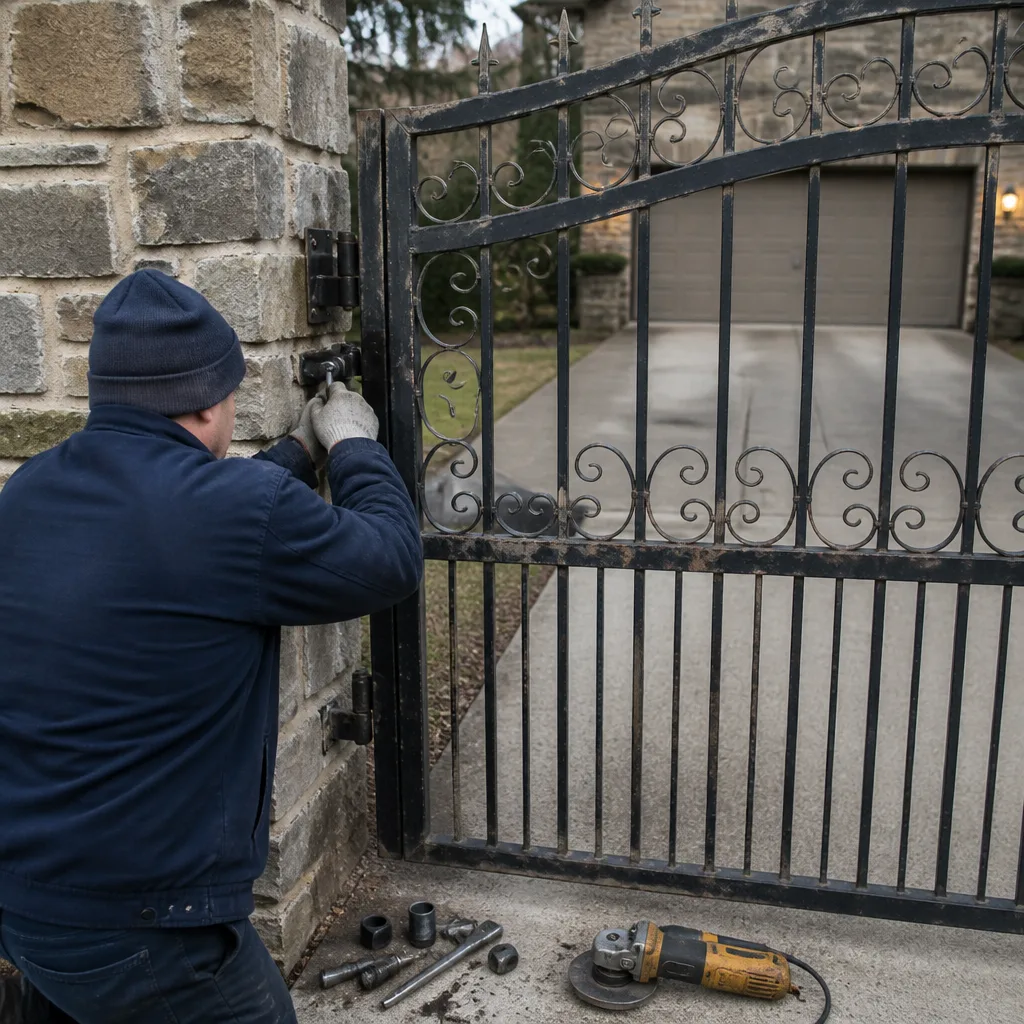 Before
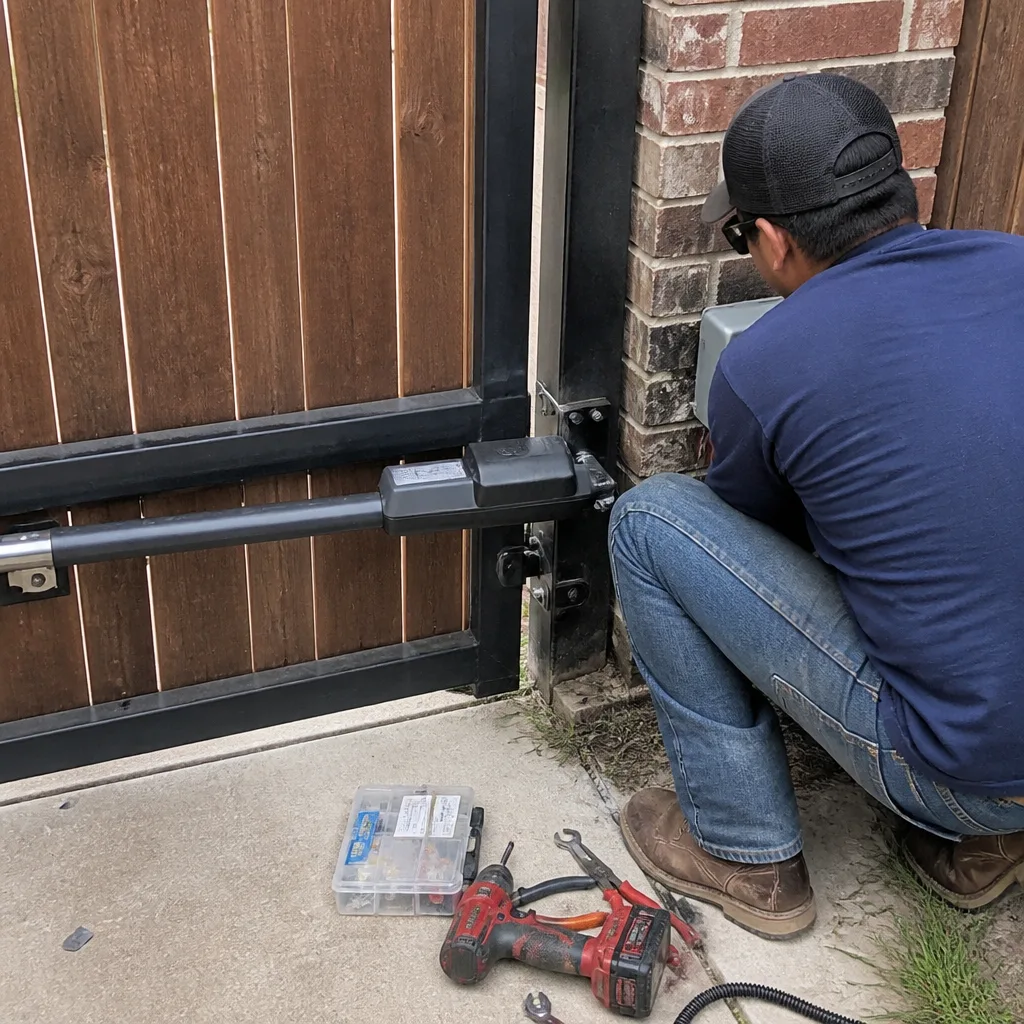 After
After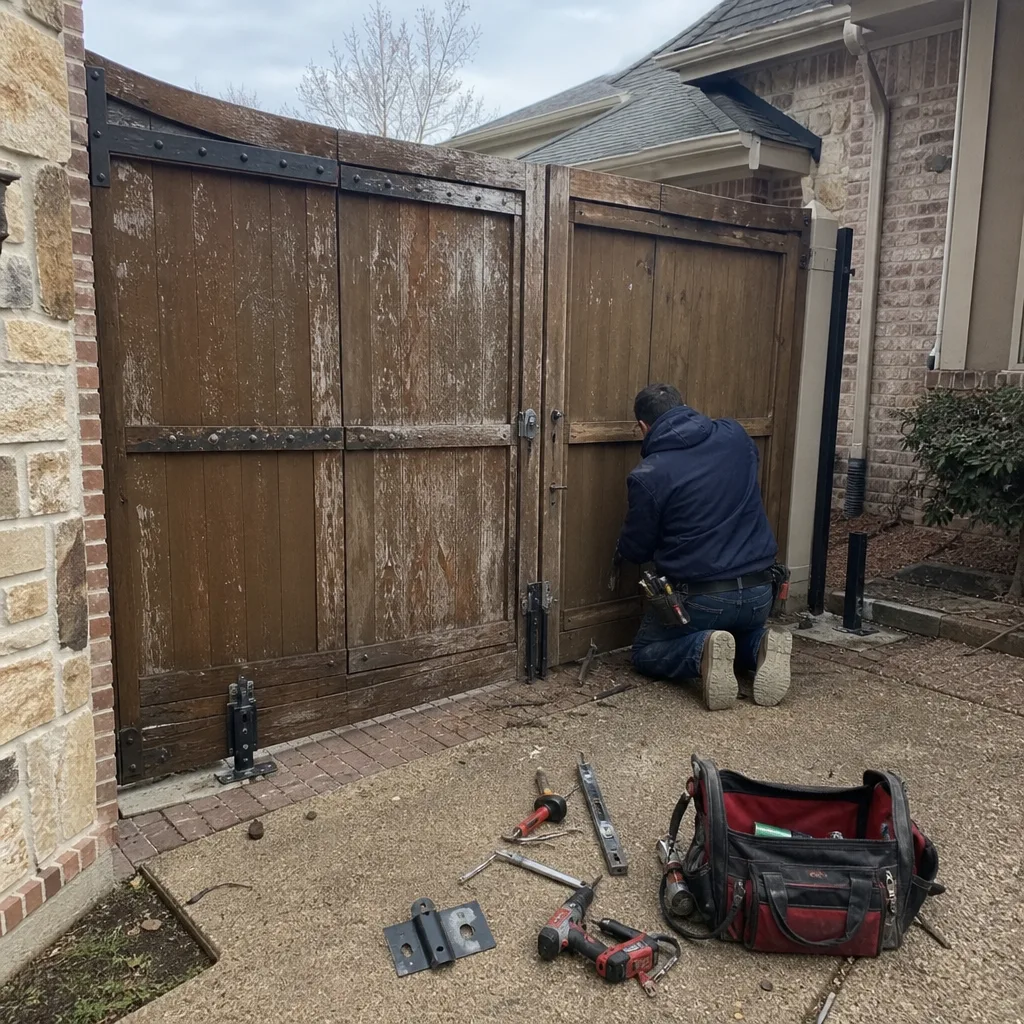 Before
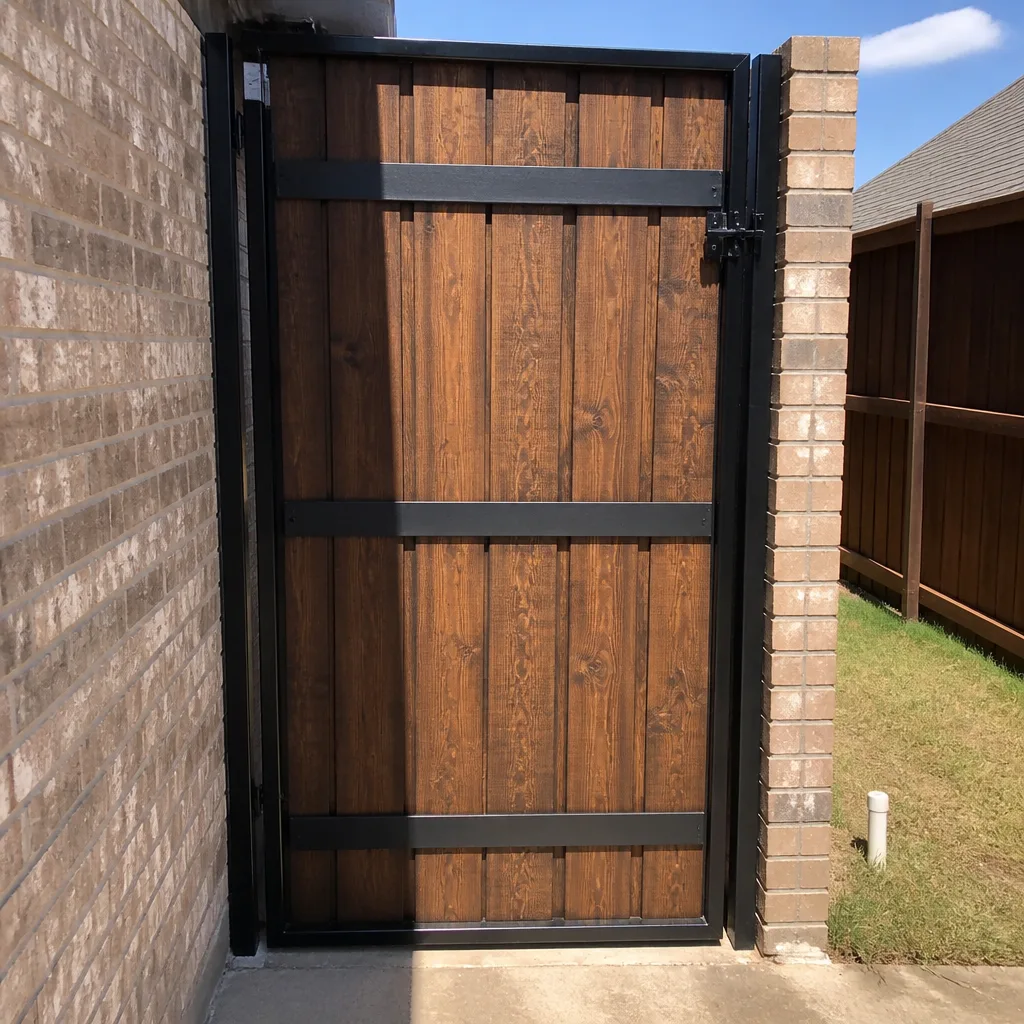 After
After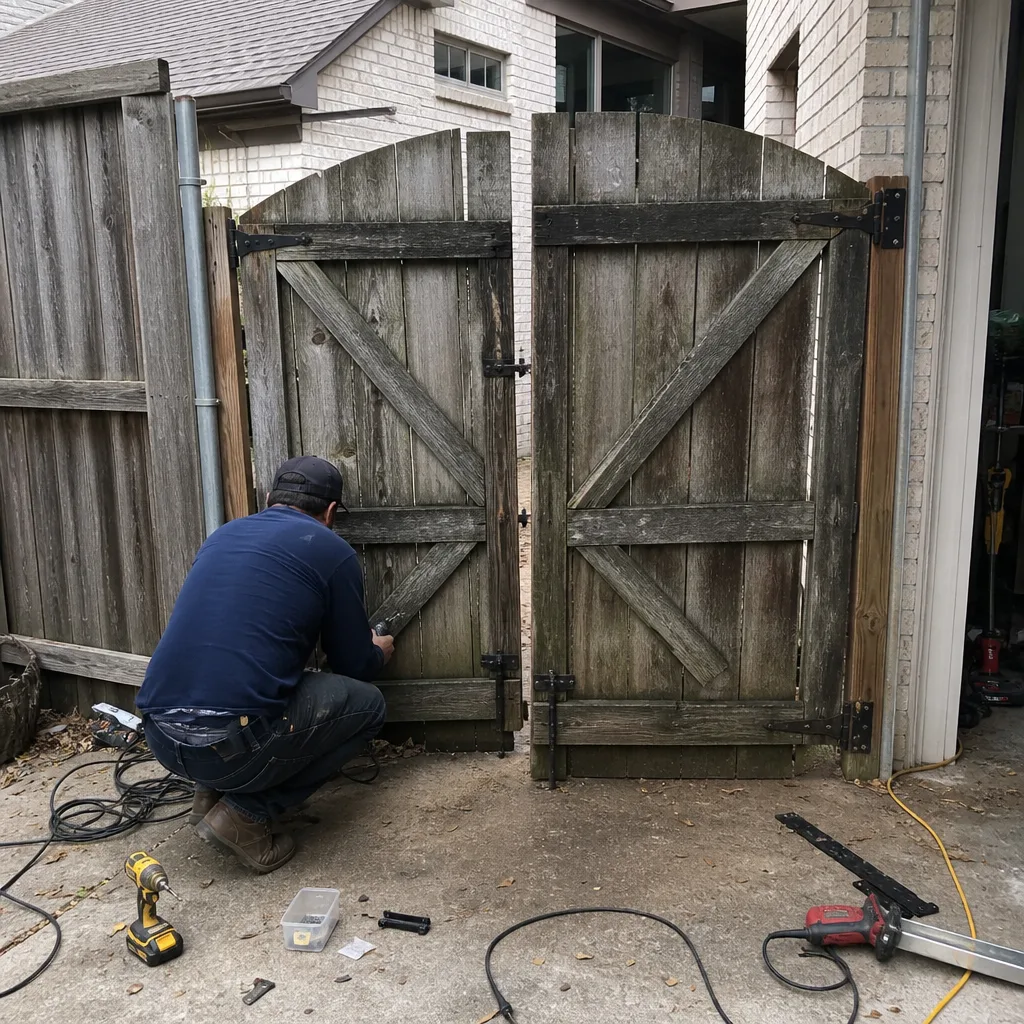 Before
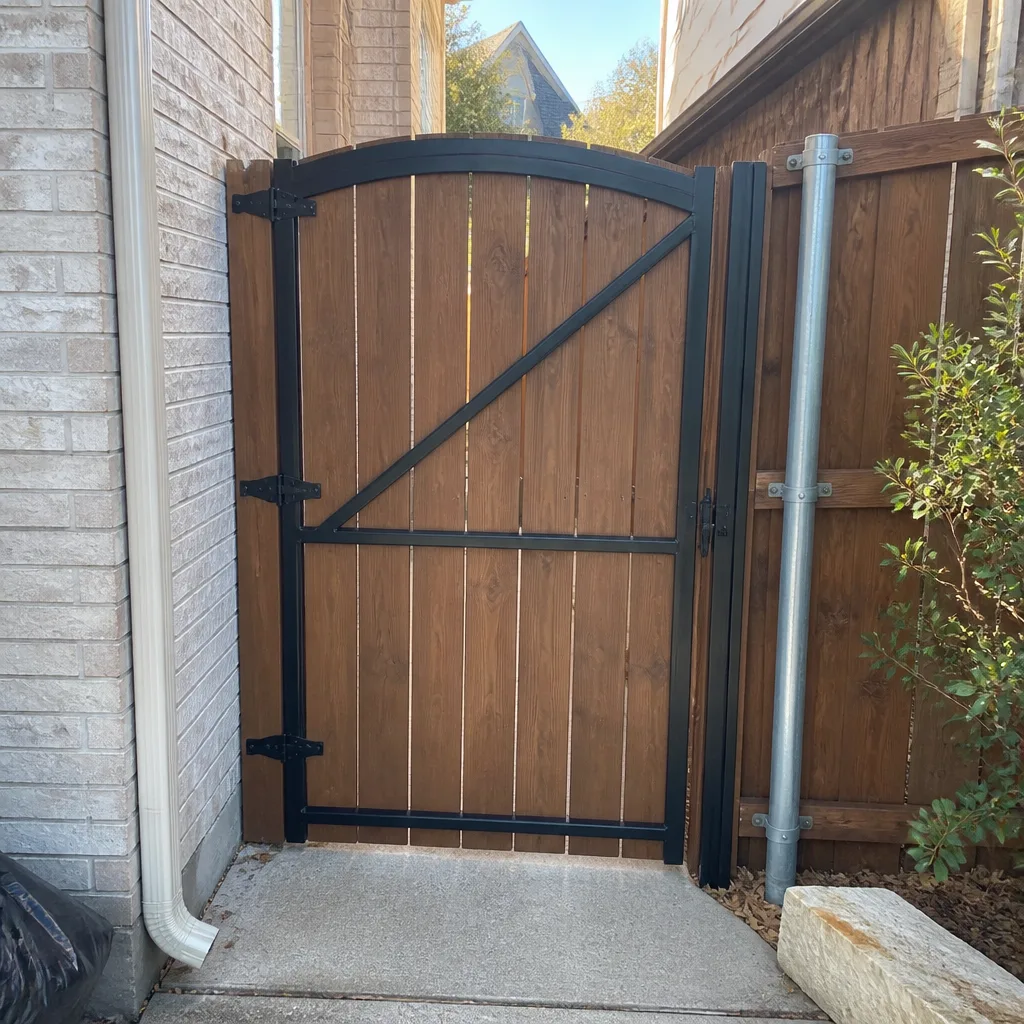 After
AfterSeasonal Gate Repair Care for Frisco: Year-Round Homeowner’s Guide
The gate that works fine in April will bind in August, not because anything broke, but because aluminum expands 0.013 inches per foot per 100°F and nobody set the limit switches with that in mind. Frisco doesn’t actually have four equal seasons. It has two failure windows, summer heat expansion and winter freeze-thaw cycles, separated by two relatively low-risk periods where almost nothing goes wrong. This guide structures maintenance around that actual pattern, not a generic quarterly checklist written for a national audience, and serves as The Complete Guide to Gate Repair in Frisco for local homeowners. You’ll learn what to check in May before the heat peaks, what to inspect after a Collin County hail event, why February battery testing matters more than any other winter task, and how to build a seasonal log a future technician can read in under five minutes.
Quick Answer
Seasonal gate care in Frisco means scheduling specific maintenance around two failure windows: limit-switch adjustment in May before thermal expansion peaks, and post-footing inspection in November before freeze-thaw cycles crack concrete. The one task that matters every single February is battery backup load testing, where anything below 12.4 volts under load signals replacement. A photo-timestamped seasonal log turns these checks into a record no future technician has to guess through.
Table of Contents
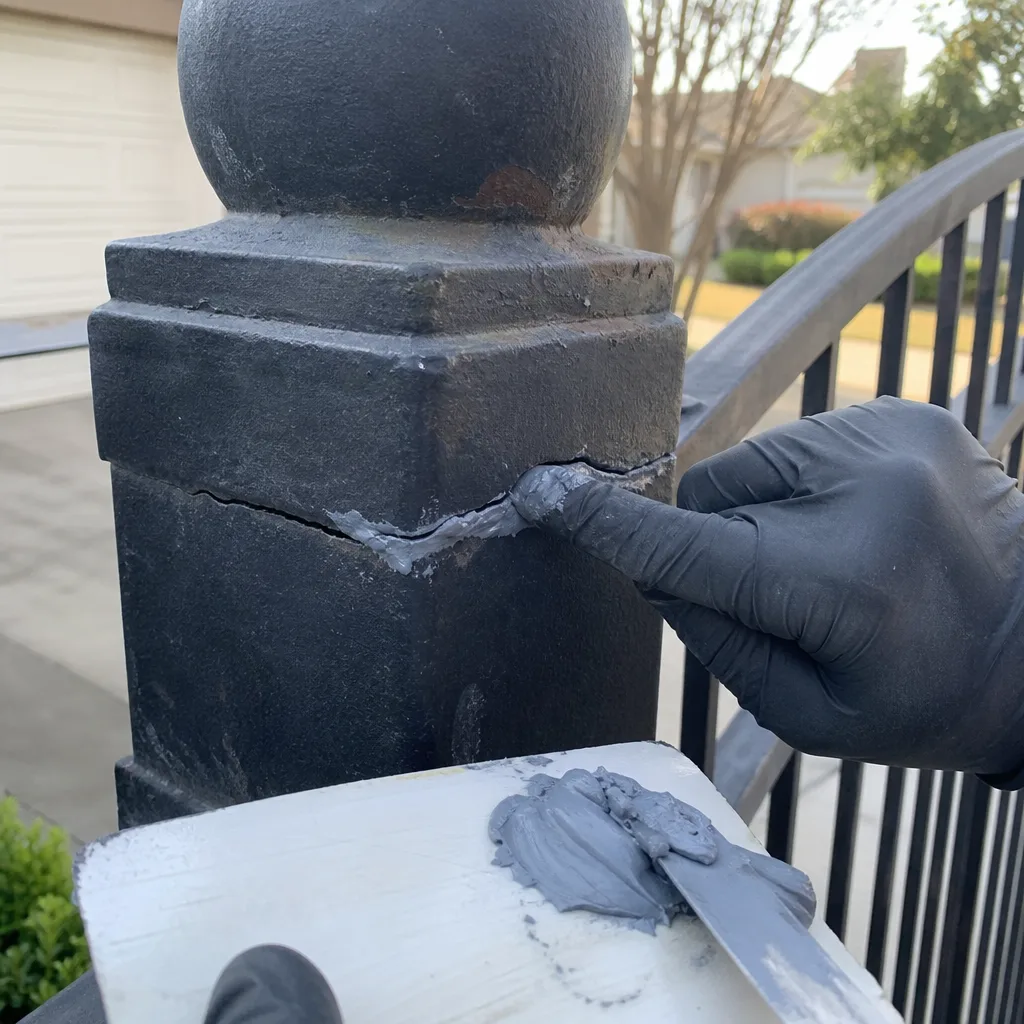
- Summer Prep (May): Adjusting Limit Switches Before Peak Heat
- Post-Storm Protocol (June-September): What Hail and Wind Actually Do to Gate Electronics
- Winter Prep (November): Freeze-Thaw Cycles and Gate Post Footings
- The February Task: Battery Backup Load Testing
- How to Build a Seasonal Log a Technician Can Read in Five Minutes
- Common Mistakes to Avoid
- When to Call a Professional
- Frequently Asked Questions
BeforeAfterSummer Prep (May): Adjusting Limit Switches Before Peak Heat
In Frisco, May is the month to act, not June. By the time the temperature sits above 95 degrees for a week straight, the metal in your gate has already moved. Aluminum expands at roughly 0.013 inches per foot per 100°F of temperature change. On a 16-foot aluminum gate, that’s over two-tenths of an inch of growth from a cool March morning to an August afternoon. On a steel gate, the rate is lower, about 0.007 inches per foot per 100°F, but the force behind the expansion is higher because steel is stiffer. What that means in practice: a gate that opened fully and closed fully in April starts slamming into its physical stop or stalling two inches short of the latch post in August.
The fix is not tightening anything or greasing anything. The fix is opening the operator housing and adjusting the limit-switch travel. A limit switch is the component that tells the motor where the gate is in its travel arc, the open position and the closed position. When it’s set correctly for cool weather, it’s wrong for hot weather. In our experience across Frisco, a limit switch set at full closed travel on a 70-degree day in April will over-drive the gate by roughly one to two degrees of arc by late July, enough to trip the obstruction sensor, throw a fault code, or bend an arm bracket on a LiftMaster or FAAC operator.
Here’s the step-by-step for a May limit-switch check that respects the thermal reality:
- With the gate in manual release, push it through its full travel at the coolest part of the day, typically early morning in May.
- Note exactly where the gate stops naturally against its end stops, not where the motor wants to push it.
- Watch the gate at 3 p.m. the same day, the warmest point, and see whether it’s still clearing the safety edges and photo-eye beams cleanly.
- If the gate now contacts the end stop harder or stalls short of the latch, the limit switch needs reset to the hot-weather position.
- Photograph the limit-switch setting on the board once adjusted. One photo of the switch position, one photo of the gate fully open, one photo of the gate fully closed. That’s the record.
One caveat before anyone reaches for a screwdriver: limit switches on a gate operator involve low-voltage control circuits, not line voltage, but the gate itself is heavy and moves under motor power. If the gate is physically binding against a post because the metal has grown beyond the switch’s range, adjusting the switch without relieving the mechanical bind can burn out the motor. That’s a job for Gate Repair professionals, not a Saturday project. And if you’re already into this work, the same May window is the right time to verify the photo-eye alignment and wipe the lenses. Dust, pollen, and construction grit accumulate fast in Frisco’s spring, and a dirty photo-eye is the most common cause of a gate that stops halfway and reverses. This is also the natural point to check the operator chain or belt tension, but on that note: a loose chain is not a chain to tighten by feel. Chain-drive operators like many BFT and Linear units have a specification in the manual, usually measured in millimeters of deflection at the midpoint. Guesswork here shortens the life of the sprocket.
Our Gate Motor & Opener in Frisco page goes deeper on the operator brands and what their maintenance intervals look like, but the May rule stands: set the travel for heat before the heat arrives, photograph the setting, and file it.
Post-Storm Protocol (June-September): What Hail and Wind Actually Do to Gate Electronics
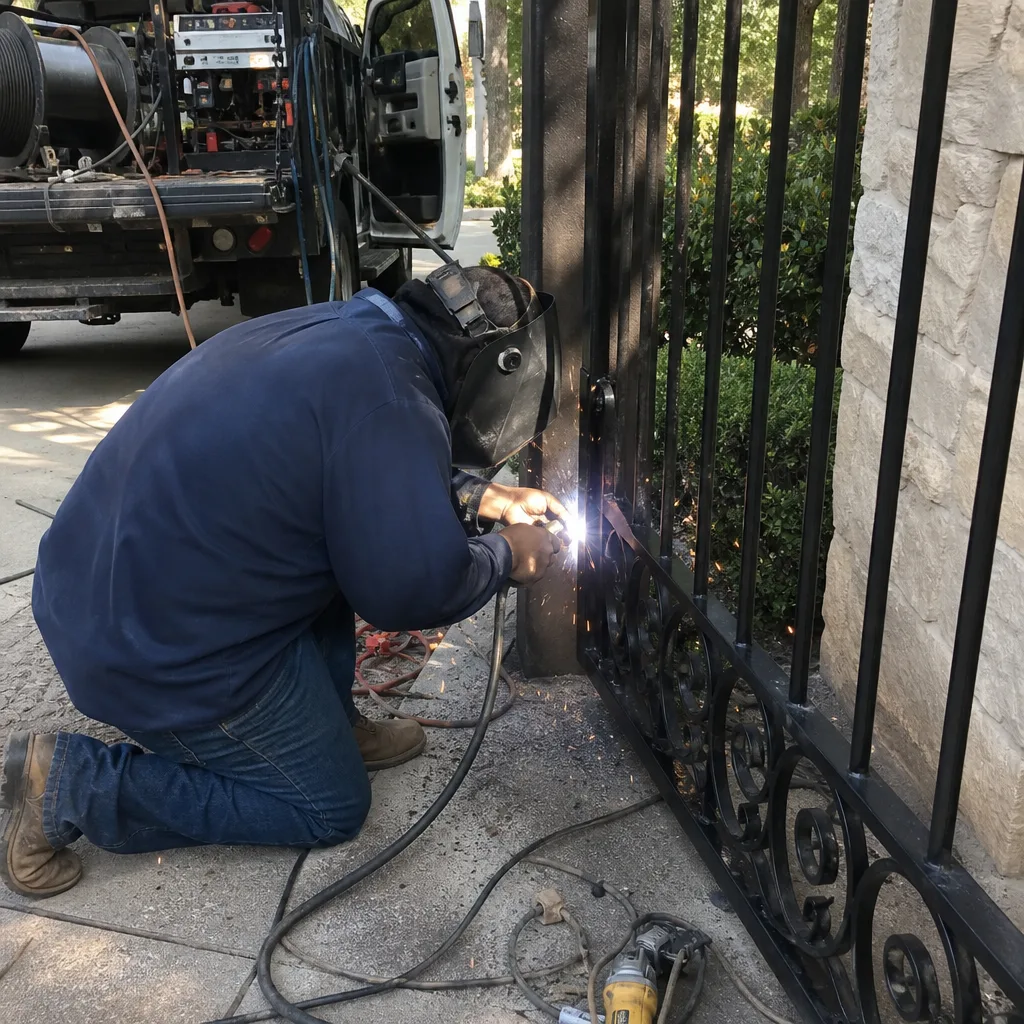
Frisco sits in Collin County, and Collin County hail season runs from March through September, peaking in April and May but spilling into June with regularity. Most homeowners walk the gate after a hailstorm and look at the metal: dents, paint chips, bent pickets. That’s the visible damage. The damage that takes gates offline comes from somewhere else, and it’s moisture ingress into the control board.
A wind-driven hail event throws rain sideways, not down. The control board inside a gate operator housing is protected from vertical rain but not horizontal rain, particularly on operator models where the access cover has a worn gasket, a cracked corner, or a mounting screw that was over-tightened and stripped. Hail itself doesn’t have to hit the operator directly. The wind that accompanies hail pushes water into seams, and after the storm, the board sits in a warm, humid enclosure. The failure might not show up for three days or three weeks. Then one morning the gate won’t open, the display shows a communication fault, and the homeowner assumes the motor just died. It didn’t. The board got wet.
Here’s the post-storm protocol that catches this early, and it’s deliberately simple because the point is to do it, not to turn the homeowner into a technician:
- Open the operator housing and look for moisture: water droplets, condensation film, a white chalky residue around the board edge, or a faint musty smell.
- Check the low-voltage wire connections for green corrosion at the terminal block.
- Look at the gasket or seal around the access cover. If it’s cracked, flattened, or missing a section, that’s a replacement, not a wipe-down.
- Test the gate twice through a full open and close cycle. A board with moisture ingress may run fine once and fault on the second cycle because the heat generated by the first run drives moisture deeper.
- Photograph any corrosion or moisture you find. A phone photo of a green terminal is a genuine diagnostic record.
If the gate ran through a storm that also knocked out power, the first question is whether the operator came back in the right mode. Power interruptions reset some operators to a default configuration, particularly on Linear and Mighty Mule units, where the force settings and travel limits can revert. After any storm that caused a power flicker, run the gate five times and listen for changes: a faster close, a harder stop, a new hesitation. Those are signs the settings have changed. This is the section of the guide where Gate Repair in Frisco becomes your next click if any of these observations turn up: moisture in the board isn’t a clean-it-and-forget-it situation. A board that has been wet once is a board that will fail eventually, and the question is whether the failure strands a car inside the driveway or just makes noise.
Winter Prep (November): Freeze-Thaw Cycles and Gate Post Footings
Frisco doesn’t get sustained cold. What Frisco gets is the freeze-thaw cycle, and that’s harder on gate post footings than a straight cold winter in Minnesota. Here’s the mechanism. Concrete is porous. Water works into the top layer of a footing, the part just below the soil line where the post enters the concrete. When the temperature drops below 32 for a few hours overnight, that water freezes and expands by about nine percent. When it thaws the next afternoon, it leaves behind a slightly larger void. One cycle does nothing visible. A hundred cycles over three Frisco winters cracks the concrete at the post base. The gate then starts to sag, and a sagging gate loads the hinges unevenly, which loads the operator unevenly, which causes the exact over-current faults that read as motor failure.
In a sustained-cold climate, the ground freezes and stays frozen. The water is locked. In Frisco, the cycle runs dozens of times each winter because nighttime lows dip below freezing while daytime highs climb back into the 40s and 50s. That repeated expansion and contraction is the failure mechanism. November is the month to catch it, before the first hard freezes arrive, because a footing that has already started cracking in November is a footing that will be significantly worse by late February.
What to look for:
- A hairline crack running radially from the post base outward across the top of the concrete, even if it’s only an eighth of an inch wide.
- A visible gap between the steel post and the surrounding concrete, where the bond has broken.
- A gate that drags or scrapes in a spot it didn’t scrape before, particularly at the latch end.
- Standing water that pools against the post base after rain and doesn’t drain away within a few hours.
- Rust staining at the base of the post where the concrete meets the steel.
The November fix that matters most is drainage. If water pools at the post base, regrade the soil around it so water moves away, or cut a shallow drainage channel if the post sits at the low point of a concrete apron. That single change reduces the freeze-thaw loading on the footing more than any sealant or caulk. If a crack is already visible, don’t fill it with an off-the-shelf concrete patch and call it fixed. A crack at a gate post base is a structural question, not a cosmetic one, because the post carries a moving load every time the gate cycles. That load turns a small crack into a larger one. A technician can assess whether the footing needs reinforcement or replacement, and this is a case where the written record matters: a photo of the crack in November gives anyone who looks at the gate in March a baseline to compare against.
While you’re outside in November, take ten minutes on the hinges and the latch. Lubricate hinge pins with a light machine oil, not WD-40, which is a solvent first and a lubricant second. Check that the latch post hasn’t shifted, because freeze-thaw works on the latch post footing the same way it works on the hinge post. And if you have a slide gate, the November task is the roller track: clean out the debris that has accumulated over the fall and verify that the rollers still ride the track without side play. A slide gate with excess side play will find the one cold morning when the track has a thin ice film and bind against it. This is the least glamorous maintenance in gate care, the drainage check and the footings inspection, but in Frisco it prevents more February failures than anything else on this list. If any November check reveals a post that has moved or a crack that has widened, that’s the time to book Gate Installation in Frisco for a repair quote, not a replacement quote, which is worth saying because a cracked footing doesn’t always mean a new gate. Often it means a re-set post and a new concrete collar.
The February Task: Battery Backup Load Testing
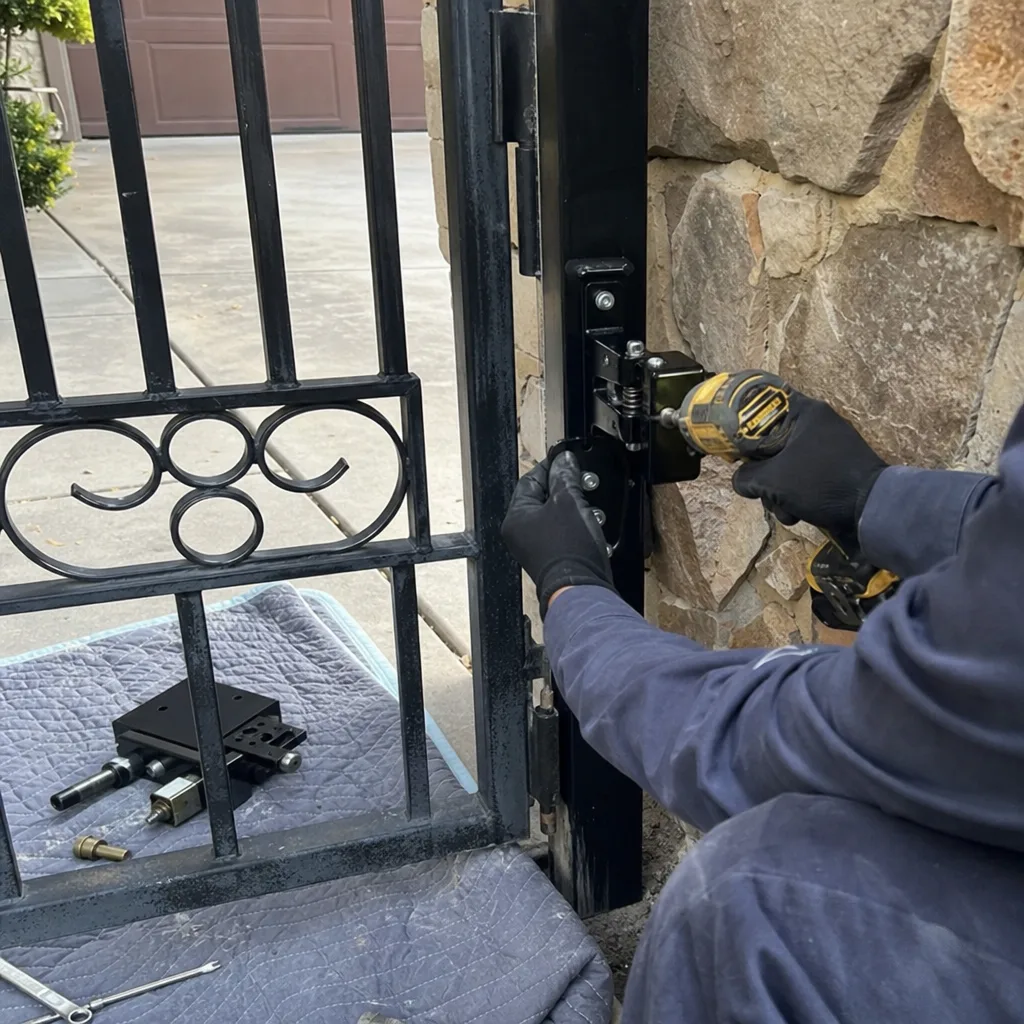
Every February, regardless of how cold or mild the winter has been, one task should happen: battery backup load testing. Not a voltage check with a multimeter at rest, which tells you almost nothing. A load test, which tells you what the battery does when it’s actually asked to move the gate.
Why February specifically? Because the battery has just spent November, December, and January doing whatever it did through the year’s worst conditions, often without being called on at all. A battery that sits on a trickle charge for months can read a healthy 13.2 volts at rest and still collapse to 10 volts the instant the operator draws current, because its capacity has degraded while its float voltage stayed fine. The load test catches that. The question is whether the battery can deliver current under load, not whether it holds a surface charge.
Here’s the test, and it doesn’t require opening the operator if the operator has an external battery compartment or a test port, which most LiftMaster and FAAC residential units do:
- Switch the operator to battery power, which usually means unplugging the transformer or throwing the AC disconnect.
- Run the gate through one full open and one full close cycle on battery only.
- Watch the gate’s speed. A healthy battery runs the gate near its normal speed. A weak battery runs it visibly slower, like a cordless drill with a dying pack.
- If the gate stalls, reverses, or faults during the battery-only cycle, the battery has failed the load test.
- Then, with the operator back on AC power, measure the battery voltage at rest and under any load condition the manual describes. Anything below 12.4 volts under load on a 12-volt sealed lead-acid battery is a replacement signal.
The homeowner question is always the same: how often should the battery be replaced? In Frisco’s heat, a sealed lead-acid backup battery in an outdoor operator typically lasts two to three years, sometimes four if the operator is shaded. The heat ages the battery even when it’s never used, because the chemical degradation rate rises with temperature. If you don’t know when the battery was last changed and the pre-2014 operator is on its original battery, just replace it. A battery backup exists for one reason: to keep the gate operable during a power outage. If the battery is dead, you won’t find out until the power goes out, and then the gate is a manual-release situation at best or a lockout at worst. Some operators are configured to auto-open or auto-close on backup power, and if the battery can’t supply the current, that configuration fails at the exact moment you need it. Power outages in Frisco are not rare, they come with ice storms and with heat-wave brownouts, two events that bracket the calendar year. The February load test is the cheap insurance against discovering the battery is dead precisely when the power is out.
When we replace a backup battery on a LiftMaster, FAAC, BFT, or Linear unit, we do it the same way every time: disconnect the AC, remove the old battery, install the new one, reconnect, run a battery-only cycle to confirm the unit performs, then photograph the installed battery with its date code visible and hand the homeowner a written record of the replacement. Haven Standard Clause 4, evidence on every job. That photo is the starting point for next February’s inspection.
How to Build a Seasonal Log a Technician Can Read in Five Minutes
The reason most gate maintenance history is useless is that it lives in the homeowner’s memory, and memory compresses. By the time a technician arrives for a repair, the homeowner remembers that something was done sometime in the spring, maybe, by someone, and the gate worked fine for a while. That’s not a record. A useful log has five qualities: it’s dated, it’s photographic, it’s specific, it’s consistent, and it’s stored somewhere that survives a phone upgrade.
The easiest form is a simple folder, physical or digital, that follows the same structure every season. Each entry gets the same four items: date, observation, action, photos. The observation says what you checked. The action says what you did or didn’t do. The photos show the thing itself. That’s it. Four items, every season, no exceptions. The log isn’t a diary. It’s a record.
A sample entry from a real Frisco gate, the kind of thing we’d hand to a homeowner, looks like this:
- Date: May 14
- Observation: Gate closed 3 inches short of latch post at 2 p.m., 94°F. No obstruction visible.
- Action: Limit switch adjusted to compensate for thermal expansion. Photos: switch position before, switch position after, gate fully closed.
- Photos: 3 timestamped images saved to the seasonal log folder, named with date and gate position.
That’s readable in under a minute, and a technician who picks up this log knows exactly what was done and can compare the current gate behavior against it. The photo timestamps are the primary record. A photo of the limit switch from May becomes the baseline against which a July problem is compared. A photo of a November footing crack becomes the baseline against which a March crack is compared. Without those timestamps, every service visit starts from scratch, and the homeowner pays to rediscover what was already known.
The formatting matters less than the discipline. Some homeowners use a paper notebook kept in the operator housing. Some use a Notes app. Some use a shared photo album. The only hard rules: every entry is dated, every observation is specific rather than vague, every photo is timestamped, and the log lives in one place. If you hand a technician a phone with a camera roll full of unsorted photos, that’s not a log. If you hand them a printed sheet with four dated entries and the corresponding photos, that’s a log. The five-minute readability is the test. If a stranger can’t understand what happened and when in under five minutes, the log doesn’t work.
We’ve built this habit into our own work because it started in commercial access control, where the site documentation is part of the job, not an add-on. Every visit leaves a record: what was found, what was set, what was installed, photographed and left with the homeowner. When a Frisco homeowner already has their own seasonal log, the combination is powerful: our record and their record, cross-checked against each other. That’s the end state this guide is pointing toward: a gate that has a history, not a gate that has a mystery.
And if you’re wondering where to start beyond your own gate, the Vance Gate Repair Frisco home page lays out how the whole service works from first call to final record.
Common Mistakes to Avoid
- Testing the gate only when it’s already broken. The May limit-switch check and the February load test are scheduled maintenance, not emergency responses. Waiting for a fault code means waiting for the most inconvenient possible day.
- Using WD-40 on hinge pins. It displaces moisture but doesn’t lubricate long-term, and it attracts dust. Light machine oil or a dedicated hinge lubricant is the right product.
- Ignoring drainage at the post base. In Frisco’s freeze-thaw climate, a post base that holds water is a post base that’s actively being destroyed. The fix is often just regrading.
- Over-tightening the operator chain. Too tight is worse than too loose. The manual specifies the deflection, often in millimeters, and guesswork here shortens component life.
- Assuming a hailstorm’s only damage is visible. The control board doesn’t care about dents. It cares about moisture. Open the housing after a wind-driven storm.
- Letting the battery backup age silently. A battery that reads fine at rest can be dead under load. The February load test is the only reliable check.
- Relying on memory instead of a log. Every technician who has to work from a vague recollection is a technician who has to diagnose from scratch, and that costs money.
When to Call a Professional
Some tasks in this guide are homeowner-friendly: wiping photo-eye lenses, checking for moisture, running a battery-only cycle, taking photos, regrading soil for drainage. For a deeper look at what to tackle yourself versus what to leave to experts, see DIY vs Professional Gate Repair: The Frisco Homeowner’s Decision Guide. Others are not. If the gate is binding against a post because the metal has expanded beyond the switch’s adjustment range, if the control board shows corrosion after a storm, if a footing crack is widening across multiple seasons, or if the gate faults when running on battery-only power, that’s a professional call. The risk isn’t just inconvenience. A gate that binds under motor load can damage the operator, the hinges, or the post, and a gate that fails at the wrong moment can trap a vehicle or leave a property unsecured. Some repair work also involves the operator’s high-tension components, and no adjustment to those parts belongs in a homeowner’s hands. Vance Gate Repair Frisco offers free estimates in Frisco, call (940) 290-7996 for a written price before any work starts.
Frequently Asked Questions
Seasonal gate maintenance in Frisco typically runs between $95 and $250 per visit depending on the operator type, gate size, and whether the work is a check-and-adjust or a replacement of parts like a battery or a limit switch. The price is written and handed over before any work starts, so there’s no invoice surprise at the end. Call (940) 290-7996 for an exact quote, estimates are free.
Adjust the limit switches in May, before the peak summer heat arrives. Thermal expansion on aluminum and steel gates changes the travel geometry by August, and setting the switches for the hot-weather position in May prevents the mid-summer binding and fault codes that come from a switch set for cool weather.
Yes. Wind-driven hail can push rain horizontally into the operator housing, even when the gate itself shows no visible dents. The damage shows up later as control-board corrosion, communication faults, or intermittent operation, often days or weeks after the storm. Post-storm inspection should always include opening the housing and checking for moisture.
Frisco’s winter freeze-thaw cycle cracks gate post footings because water in the porous concrete freezes overnight, expands by about nine percent, and thaws the next afternoon. Dozens of these cycles across a winter create voids that grow into visible cracks, which is why November footing inspection matters more in Frisco than in a sustained-cold climate.
Switch the operator to battery power, run the gate through a full open and close cycle on battery only, and watch the speed. A healthy battery runs the gate at near-normal speed. A slow gate, a stalled gate, or a voltage reading below 12.4 volts under load means replacement, and this test should happen every February.
Each entry contains four items: the date, a specific observation (what you checked and what you saw), the action taken, and timestamped photos. The log lives in one place and stays consistent from season to season. The test is that a technician can read it and understand the gate’s history in under five minutes.
The Bottom Line
Frisco gate care succeeds or fails on the calendar. May is for limit switches, because heat expansion is predictable and setting travel before the heat arrives prevents the binding. November is for footings and drainage, because freeze-thaw cycles in our climate do more structural damage than sustained cold. February is for the battery load test, the one task that doesn’t change no matter how mild the winter. The seasonal log ties it together, with photos and dates and specific observations replacing memory. For more guides & resources on keeping your gate running year-round, explore our blog. Do these four things and the gate that works fine in April will keep working fine in August, and the repair calls that do come will start from a record, not a guess.
Written by Adrian Vance, Owner at Vance Gate Repair Frisco, serving Frisco since 2014.